
Understanding the Bazball Meta

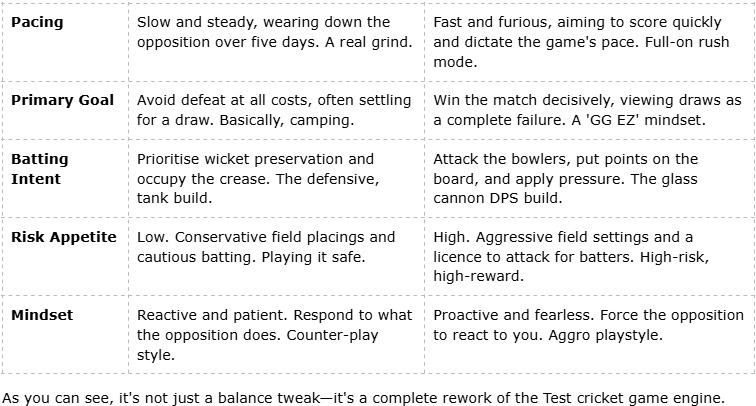
If traditional Test cricket was a slow-burn RTS, Bazball is an all-out arena shooter. The objective isn’t just to survive; it’s to dominate. It’s about scoring fast, making high-risk plays, and seizing control of the match’s tempo to force a win. Playing for a draw is like leaving a match early—it’s just not in the playbook.
This entire approach is designed to feel like a constant gank, where every player is given the green light to go big and play without fear. The name itself is a simple mash-up of head coach Brendon McCullum’s gamertag, ‘Baz’, and the word ‘ball’—perfect shorthand for this fearless brand of cricket.
To truly get the patch notes, let’s break down how the new build stacks up against the old meta.

The Brains Behind the Operation
The devs of this revolution are head coach Brendon McCullum and captain Ben Stokes. They took over an England side that was on a massive losing streak, having won just one of its previous 17 matches, playing a style that was stale and predictable.
Their first move was to completely change the team’s culture. They focused on removing the “fear of failure” debuff that had nerfed players for years. Getting out while trying to be aggressive was no longer a mistake; it was a sign of the right intent. Players were encouraged to trust their instincts and play with total freedom.
“Bazball is no longer about recklessness but about playing with purpose, confidence, and trust in one another. These are qualities that have been built, refined, and tested over time.”
This fundamental shift changed everything. The core tenets of this new era are simple but OP:
- Hyper-Aggressive Batting: Batters are expected to score at a rate that would be impressive in a shorter game mode, often targeting a team run rate of over 4.5 runs per over.
- Constant Pressure: The aim is to never let the opposition farm or level up. Whether with the bat or the ball, England looks to control the map and keep their opponents scrambling.
- A Winning Mindset: The team is always looking for a win condition, no matter how low their HP gets. A draw is seen as a last resort, not a satisfactory outcome.
This bold strategy hasn’t just brought England success; it’s completely changed the global meta, forcing other nations to develop new counter-strategies to this relentless aggro playstyle.
The Lore Behind the Bazball Rework
Every game-changing meta has an origin story, and Bazball’s is a classic tale of a team hitting rock bottom and rage-quitting their old strategy. Before this major overhaul, the England Test squad was in a terrible state, playing a timid, predictable game that was easy for opponents to counter. The stats were grim: they had scraped together just one win in 17 matches. Their game plan was broken, lacked any real intent, and was desperately crying out for a fresh install.
That new beginning arrived in May 2022. The admins at the England and Wales Cricket Board brought in new leadership. Brendon McCullum, the former New Zealand superstar known for his own hyper-aggressive playstyle, was appointed head coach. He was joined by Ben Stokes, a player defined by his clutch plays and fearless attitude, who took over as captain.
Uninstalling the Fear Malware
The new leadership duo immediately zeroed in on the core bug: the entire team was crippled by a fear of failure. Players were so worried about getting eliminated that they couldn’t play their natural, attacking game. They were stuck trying to survive rather than actively pushing for a win.
McCullum and Stokes’s first mission was to completely wipe this negative programming from the team’s mindset. Their vision was simple but incredibly powerful. They wanted to build an environment where players felt free to express themselves and attack without constantly worrying about their K/D ratio.
Their core philosophy was to get rid of any doubt and replace it with total belief. It was about empowering players to go for the big, game-changing moments rather than protecting their individual stats.
This wasn’t just a minor patch; it was a complete cultural reset. The team’s story arc began right there, rising from the ashes with a new objective: to make Test cricket thrilling again. McCullum’s own career was the blueprint—he was a player who always looked to dominate, never to simply grind.
The conditions were perfect for a dramatic change. The team had nothing left to lose, and the new leadership came in with a clear, aggressive game plan that promised to change not just their own results, but the way Test cricket was played. The stage was set for the Bazball era to begin.
The Bazball Tactical Playbook Unpacked

Let’s get one thing straight: Bazball isn’t just about button-mashing and hoping for the best. That’s a massive oversimplification. At its heart, it’s a calculated, high-risk, high-reward tactical system designed to seize control of the game and never let go.
Think of it as a relentless pressure tactic. The core idea is to score at a blistering pace, often aiming for 4.5 to 5 runs per over. This isn’t just about racking up points; it’s a psychological assault. It forces bowlers off their ideal lines, makes captains rip up their field plans, and puts the entire opposition on tilt.
When a team is constantly reacting to your aggression, they aren’t playing their own game anymore. They’re just trying to survive yours. That’s how a Bazball side dictates the entire flow of the match.
Redefining Player Roles
Under this system, traditional player roles get thrown out the window. Every single batter, from the opener down to the support player at number eleven, is expected to be a damage-dealer. Their job is simple: get out there and score quickly.
There’s no room for cautious blocking or playing for a draw. Each player has a licence to be aggressive, turning the entire batting line-up into one long, intimidating rush. It’s a kind of pressure that most bowling attacks simply aren’t specced to withstand for five days.
Bazball dictates that the best form of defence is an overwhelming offence. It’s a philosophy that believes in landing the first punch and never letting up, ensuring the opponent is always reacting and never initiating.
This mindset means that even when a player is eliminated, the pressure doesn’t ease up. The next player spawns in with the same aggressive intent, maintaining the momentum and giving the fielding side absolutely no time to reset.
Bowling and Fielding The Bazball Way
This aggressive streak isn’t just confined to the batters. The bowlers are encouraged to hunt for kills at all times, even if it means leaking a few more runs than usual. The priority is taking all ten wickets, not simply containing the scoring rate.
Field settings are just as bold and unconventional. You’ll often see strange, attacking formations designed to bait a batter into a mistake. These aren’t defensive setups meant to stop runs; they are clever traps designed to create opportunities out of thin air.
- Aggressive Bowling: The focus is always on wicket-taking deliveries, not just dot balls. It’s about kills, not assists.
- Attacking Fields: Unorthodox placements are used to set traps and apply mental pressure, like a well-timed gank.
- Psychological Warfare: The constant, relentless attack is designed to wear down the opposition mentally and put them on tilt.
By applying this attacking doctrine to every single part of the game, the team operates as a single, unified force. Every player has the same clear objective, making them a formidable and unpredictable opponent. This complete tactical alignment is the real secret to Bazball’s effectiveness.
Legendary Wins and Epic Fails
Every high-risk, high-reward strategy is ultimately defined by its most glorious wins and its most spectacular fails. So, let’s look at the replays and break down the moments Bazball looked OP, and when it just, well, got nerfed.
These are the matches that serve as undeniable proof of the philosophy’s power, showing exactly what can happen when a team fully commits to the rush. But we also have to look at the times when that same hyper-aggression led to a team wipe, reminding everyone that even the boldest plans can have a bad day.
Mission Accomplished: The Greatest Hits
When Bazball clicks, it’s not just a win; it’s a statement. It creates highlight-reel moments that seem to break the game’s physics, leaving opponents and spectators alike wondering what on earth just happened.
One of the earliest and most defining examples came against Pakistan in Rawalpindi. On a map that was flat and seemingly destined for a boring draw, England went into overdrive. They bludgeoned over 500 runs on the very first day, a feat that most thought was completely impossible in a Test match.
Then came the legendary final boss battle against India at Edgbaston in 2022. England was facing a mammoth target of 378 – a score that would have 99% of teams turtling and playing for survival. Instead, they treated it like a speedrun, hunting it down in just 76.4 overs. They made an almost impossible task look shockingly easy.
It’s in these high-pressure, clutch situations that Bazball truly comes alive. It transforms daunting, defensive scenarios into aggressive, winnable ones by flipping the script and putting all the pressure right back on the bowlers.
These victories proved to the world that this was no mere gimmick. It was a legitimate, game-changing meta capable of achieving unbelievable results by completely rewriting the unwritten rules of Test match cricket.
When the Gamble Doesn’t Pay Off
Of course, going all-in doesn’t always end in glory. Sometimes, the plan backfires in dramatic fashion, leading to team wipes that are just as memorable as the victories, though for very different reasons. When the conditions aren’t right or the opposition has a smart counter-strat, Bazball can look less like a masterstroke and more like a reckless bet that went wrong.
These fails often happen when intent isn’t matched by execution. A flurry of rash plays can lead to a string of cheap eliminations, handing the advantage straight to the fielding side. The biggest weakness is that there is no ‘Plan B’. If the all-out assault fails, the innings can unravel in a hurry.
This has been most obvious in matches against top-tier opponents like Australia and India, where disciplined bowling and intelligent field placements have successfully absorbed the pressure and exploited the strategy. England’s mixed record against these powerhouse teams shows that while the approach is potent, it’s certainly not foolproof.
The stats from England’s 24 Bazball Test wins since 2022 still paint an incredible picture, full of jaw-dropping chases and moments that are especially relevant for Indian cricket fans. That epic 378 chase at Edgbaston was completed before the second new ball was even due. A tight 26-run win in Multan was set up by scoring 281 in just two sessions on day one. To see more, check out the most ridiculous Bazball Test wins on Wisden.com.
The Stats Behind the Strategy
Talk is cheap, but the numbers don’t lie. So, does the Bazball strategy actually hold up when you dive into the analytics? Let’s break down the hard data to see the real impact of this high-octane approach.
The most obvious advantage is the sheer scoring speed. England’s team run rate has gone through the roof. Before this new era, scoring at four runs an over was considered rapid Test cricket. Under Bazball, that’s just the warm-up.
This new pace isn’t just a minor tweak; it’s a statistical outlier that completely reshapes the dynamic of a five-day match. It puts immense pressure on opponents from ball one and allows England to control the map like never before.
The infographic below highlights some of the most impressive statistical feats from this period.
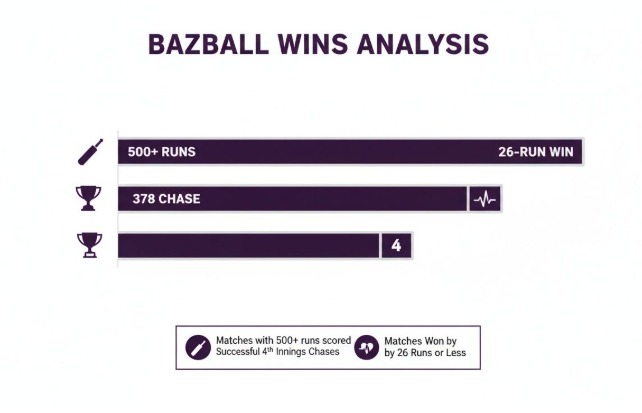
These numbers show that Bazball produces incredible outcomes, from huge first-day totals to record-breaking run chases and nail-biting victories.
The Proof Is in the Numbers
The data gives us clear evidence of the strategy’s effect. In the Bazball era, stretching from June 2022 to December 2024, England’s scoring rate stood at an unprecedented 4.61 runs per over across 35 Tests.
To put that in perspective, this figure blew the global Test average of 3.59 out of the water during the same period. No other team had ever sustained a rate over 4 runs per over for such a long stretch. The next quickest team, India, was a distant second at 3.58.
This aggressive style has translated directly into results, delivering 22 wins against only 12 losses. It’s a win/loss ratio that speaks for itself, proving the high-risk approach often brings high rewards.
The Weaknesses and Counters
However, every powerful strategy has a counter. The weakness of Bazball becomes apparent when facing the very best teams, particularly in their own home base. The data reveals a significant drop-off in performance against the game’s giants.
Against elite teams like Australia and India, England’s win percentage is roughly half of what it is against other nations. This suggests that the best bowling attacks and sharpest tactical minds have found ways to exploit the system’s weaknesses.
The core vulnerabilities of what is bazball in cricket are clear:
- No Plan B: When the all-out attack fails, the team can suffer dramatic team wipes with no defensive fallback to steady the ship.
- Vulnerability to Skilled Bowling: Disciplined, world-class bowlers can absorb the initial onslaught and use the aggression against the batters, setting traps and forcing mistakes.
- Challenging Conditions: On maps that offer significant buffs to bowlers (think seaming green tops or spinning dust bowls), high-risk shots become even more dangerous, often leading to a procession of eliminations.
Ultimately, the stats show Bazball is a potent, game-altering strategy. It has massively boosted England’s win rate and redefined scoring in Test cricket. But it’s not invincible. Its clear struggles against the world’s best teams show there’s still room for refinement.
Why Bazball Changed the Game for Fans

So, why should anyone outside the cricket bubble care about Bazball? Because it completely transformed the spectator experience. It took the longest format of the game—often seen as a slow, strategic grind—and turned it into unmissable, edge-of-your-seat entertainment.
Think of it like a developer releasing an update that turns a slow-burn strategy game into a high-octane action blockbuster. The fundamental rules are the same, but the pace and excitement have been cranked up to eleven. This shift has made Test cricket genuinely thrilling for a whole new generation.
A New Meta for a New Audience
This relentless aggression has pulled in younger audiences who previously found the five-day format too sluggish. Every session now feels like a high-stakes showdown, packed with action and moments that can flip the game on its head. It’s no longer just for the purists; it’s prime-time viewing.
But don’t mistake aggression for recklessness. This approach has also shown incredible stamina. During the 2025 India tour of England, the team piled on a massive 669 runs in a single innings at Old Trafford, batting for 157.1 overs. This was both their highest home total and longest innings of the era, proving Bazball can play the long game when needed. You can dig into the details of this record-breaking performance at apostalista.com.br.
Bazball isn’t just a fleeting trend; it’s a new meta that has forced a global rethink. Other teams now have to figure out how to counter this attacking philosophy.
This ripple effect means Test cricket is more dynamic and unpredictable than ever. Bazball has successfully given the sport a shot of adrenaline, ensuring its future is just as exciting as its storied past.
Answering Your Bazball FAQs
Still got a few questions buzzing around about what Bazball is all about? Let’s clear up any lingering confusion with some quick-fire answers.
Is Bazball Just Reckless Hitting?
Not a chance. From the spectator view, it might look like a non-stop button-mash, but it’s actually a deeply calculated strategy. The real aim is to put relentless pressure on the opposition, forcing bowlers and fielders into mistakes they wouldn’t normally make.
Players are given the freedom and, crucially, the backing from the leadership to play their natural, aggressive game. This removes the ‘fear of failure’ debuff that can paralyse a batter in Test cricket. So, it’s not about blindly swinging at every ball; it’s about smart, positive intent.
Has Any Other Team Successfully Copied Bazball?
While no one has gone full-clone on the Bazball build just yet, its influence has been massive. You can see its ripple effect in how top teams like Australia and India now approach Test matches.
Their scoring rates have crept up, and opposition captains are setting more attacking fields than they used to. It’s forced a global rethink of how Test cricket can be played, even if other teams are only borrowing parts of the blueprint rather than adopting it wholesale.
“Bazball is still brave and entertaining, but it is also thoughtful, strategic and grounded in a deep understanding of the game. It is no longer about recklessness but about playing with purpose, confidence, and trust in one another.”
Who Came Up With the Name Bazball?
The term ‘Bazball’ was actually coined by a journalist, Andrew Miller, over at ESPNcricinfo. It’s a simple and catchy nod to England’s head coach, Brendon McCullum, whose famous nickname is ‘Baz’.
Interestingly, McCullum himself has said he’s not a fan of the term. He feels it oversimplifies the thoughtful, strategic cricket his team is playing. Despite his reservations, the name stuck like glue and is now the universal shorthand for England’s electrifying brand of cricket.



Deixe um comentário